Apprenticeship Degrees Are Gaining Ground. What Will It Take to Scale?
A few years ago, combining a college degree with a paid apprenticeship was unfamiliar. Today, Apprenticeship Degrees are taking hold across higher education, government, and the workforce. As the model grows, the question is shifting from whether Apprenticeship Degrees can work to what it will take to scale them.
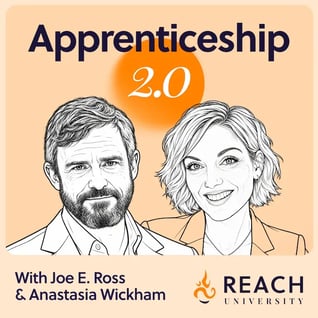 On this episode of Apprenticeship 2.0, Reach University President Joe E. Ross is joined by Reach co-founder Dr. Mallory Dwinal-Palisch, now president of Craft Education, to take stock of where the field stands and what comes next.
Using a framework of “easy truths,” “impossible things,” and “true secrets,” Joe and Mallory examine some of the assumptions surrounding Apprenticeship Degrees, including the role of accreditors, the need for new curriculum, and the less visible work of controlling costs, braiding public funding, building strong employer partnerships, and giving academic credit for learning at work.
The following transcript has been edited for brevity and clarity. To hear the full episode, please listen and subscribe on Apple Podcasts, Spotify, or wherever you get your podcasts.
Joe: I was thinking about how to think about this conversation, Mallory, and my attention was drawn to the entrepreneurship involved in this work, not just your entrepreneurship, but the entrepreneurship generally that we're asking of this field of higher ed and of employers and policymakers.
Peter Thiel wrote one of my favorite books on entrepreneurship. It's called Zero to One. And in that book, he distinguishes between what he calls easy truths, impossible things, and true secrets.
Easy truths are things that everybody agrees with. Impossible things are those mysteries or those intransigent things that nobody can reasonably expect to solve. True secrets fall somewhere in the middle. They're difficult to find; they're possible to find, but few people do.
I thought maybe we would try to dissect the field and diagnose the state of the approach in that framework. What do you think?
Mallory: With all our leftover time, we can tackle world hunger and conflict and get to world peace by the end of this.
Joe: We're just going to change everything. That's the name of the game here.
Let's start with the easy truths. What are those easy truths now that are actually wildly different from the assumptions of two or three years ago?
Mallory: I would say that Apprenticeship Degrees can exist in the United States and that there's an appetite for them.
Not too long ago, you and I got a nastygram from a nameless figure at the Department of Labor via one of our funders saying, “Stop telling people about these things called Apprenticeship Degrees. That doesn't exist in the United States.”
In 2022, Tennessee became the first state in the country to have Office of Apprenticeship recognition of apprentices in teaching. Some still argued that they needed to complete the full degree and then do an apprenticeship afterward.
Now, people take for granted that the degree itself will be shaped around that apprenticeship. But that was not a given a few years back.
Joe: The thing now is not whether it's a thing, but how to make the thing work.
Are Accreditors Really the Obstacle?
Joe: I want to suggest that some of the barriers are now understood as conventional wisdom as well, including the challenge posed by programmatic accreditors.
My sense is that people understand that, when it comes to nursing apprenticeship, behavioral health apprenticeship, or teaching apprenticeship, programmatic accreditors are not making it easy to keep things affordable, workforce-based, or to earn credit for work.
Mallory: Absolutely not. I think that is nonsense.
When we first started this out, institutional accreditors were the boogeyman. Every time I would talk to a four-year institution, it was, “I wish we could, but our institutional accreditor won't let us.”
We did not have that problem when we got Reach accredited. And then we went around and talked to other institutional accreditors at Craft and heard them say the same thing: “I love this. Let me help.”
My thesis is that now you have a different name for the same game. Institutions are saying, “Institutional accreditors aren't the problem. It's these programmatic accreditors.”
I have been so impressed in the work that we have done with groups accrediting actual programs in this space. They believe in this work. They believe in making it more equitable. They believe that more work experience from day one produces better practitioners.
Joe: You're saying the conventional wisdom isn't an easy truth. It's an easy falsehood.
Mallory: I think they're having a conversation about inputs rather than outputs and outcomes.
Instead, start with: What is the purpose of programmatic accreditation? Who is it here to protect? What qualities is it meant to uphold?
We're not saying you should get rid of policy and put nothing else in place. We're saying: How can we get the same outcome we're trying to protect without unnecessary collateral damage?
The Realities Working Adults Cannot Design Around
Joe: Let's talk about the impossible things. These are the mysterious or intransigent things that we shouldn't expect to change, that we have to design around or live with. Where does your mind go?
Mallory: Inequality in America.
A lot of people are living inside of hardship, and higher education unto itself is not a guaranteed outcome.
We cannot design systems that assume learners can afford financial shocks or unexpected bumps in the night, that they can afford to be out of the workforce, or that they can afford to get a college degree and just cross their fingers that there's going to be a job on the other side that makes use of that and compensates them.
Joe: What you're saying is that the working adults in this country who could take advantage of an Apprenticeship Degree will not be able to do certain things along the way.
They will not be able to leave their community. They will not be able to take on an additional expense. They will not be able to stop working. They will not be able to assume that it's okay to take on debt.
In most counties, in most places in this country, the talent that's in waiting isn't moving somewhere to get trained, isn't quitting their job to get trained, and can't afford to.
Mallory: Correct. And that training can't have an employment strategy on the other end of “hope and pray.”
The Work Behind Scaling Apprenticeship Degrees
Joe: Let's talk about the little-known but important true secrets that could really open up the field to more Apprenticeship Degrees. You teased this a little bit a few minutes ago. What's on your mind?
Mallory: All of higher ed looks around and says, “Apprenticeship is possible. We can build more experiential workforce programs.”
And then their first thought is the wrong one: That's going to be a curricular innovation. We need to create whole new content.
I don't think that's it.
The groups that will carry the day are the ones that get serious about cost containment. Don't add more bells and whistles. If the program is too expensive, adding new features that make it even a dollar more expensive does not work.
Then it's about fund braiding and making yourself compliant with the federal funds that could be used to offset programming.
The money is there, but the innovation is not building new curriculum. It is getting your cost down, and then it is getting smart about how you braid together those funds to cover that sticker price.
Joe: When we talk about the ABCs, it's kind of a simplification of what's different about the hybrid model when it's an Apprenticeship Degree.
Affordability is about the braiding of revenue and about your internal costs being re-engineered. And that's a huge part of what this requires.
Mallory: And about being able to get paid the whole time. If it's not costing you anything, but you can't work, I can't afford to sit at home all day if I don't spend anything. I still have bills to pay.
Joe: A is for affordability and B is for being based in the workplace from day one to the day of graduation, where it starts with a paid job and it ends with a better-paid job.
And C, standing for credit for learning at work, is about figuring out ways to give credit where credit is due for competencies demonstrated on the job, for work done on the job, for prior learning, and looking for ways to integrate that into your program.
Those are the innovations.
Rethinking Mentorship and Workforce Partnerships
Joe: When you integrate with apprenticeship in your workplace, there's a conception that you need to have a full-time, one-on-one relationship between a mentor who's paid for and a learner the whole time.
What you need is a journey worker who can attest and validate that you demonstrated a skill in the moment you're demonstrating a skill.
One of the things we're seeing that's enabling growth in teacher apprenticeships are models where, in the first two or three years of the apprenticeship, you can show something in your classroom as a paraeducator, and the teacher can validate that you did something without having a cumbersome one-on-one relationship.
Then when you get to the clinical rotation phase, absolutely, you're supposed to have more one-on-one assigned mentorship.
Mallory: It comes back to the same thing we're talking about with programmatic accreditors. What is the North Star of having a journey worker?
It is to make sure that person isn't just out in the wilderness divining things on their own and that they're actually learning from someone qualified to show them the way.
A paraprofessional is a paraprofessional in someone's classroom. So why isn't that person their journey worker?
Joe: I think this is one of those little-known secrets: workforce boards actually are eager to play. The conventional wisdom is that they're not. That's not my experience.
Mallory: If you come to a workforce board and don't think about what their job is, you're going to experience friction.
But if you come in and have that conversation with them of, “You've got all these people making minimum wage with no benefits, with no pension, with no retirement, who are trying to find their way into the teaching workforce and are first-gen, low-income. Help me help that person.”
I have never had a workforce board say, “That's not my job.”
What Happens to the Liberal Arts in the Age of AI?
Joe: What about liberal arts?
Mallory: Liberal arts are going to rise again. AI is making that obvious.
Employers are actively going out and recruiting philosophy majors and literature majors and history majors who've been taught how to think and reason and make judgment calls.
Joe: At a minimum, you want people to know how to argue with their AI.
Mallory: And how do you learn how to argue with your AI other than learning how to argue with humans first?
Building the Infrastructure for What Comes Next
Joe: Speaking of the braiding of funding, wouldn't it be great if there was a technology solution that made that easier?
Mallory: If only.
What Craft believes at its core is that there are two things that are necessary for Apprenticeship Degrees, or work-based degrees in general, to be mainstream: credit for your work and fund braiding to offset the cost of tuition.
We believe the big rate-limiting factor to that is data.
The institutional and programmatic accreditors and licensure boards on the credit side, but then also all of the statutory groups that oversee different piles of money, all want the same data. They just collect it in different ways, on different schedules, through different portals.
It gets so confusing that people walk away, and they leave money on the table and they leave credit on the table.
Our belief is that we can collect that data one time and then make it compliant everywhere and automate that reporting.
Looking Ahead
Joe: Let's look ahead. You hinted at what our conversation will sound like two years from now.
Mallory: In general, I think the economy is going to split along two vectors: the care economy, particularly healthcare, and then everything else.
The care economy is teachers, nurses, social and allied health, early childhood, et cetera. I think we will see that sector really double down on apprenticeships because they have licensure, they have questions around needing a college degree to do the jobs, and all the things we talked about as a human, being able to afford it and being able to work while you do it, will matter.
And it's got to be place-based. People aren't going to leave their community to come back and be a preschool teacher.
I think we're going to see Apprenticeship Degrees take off in the care economy. And to do that, at a minimum, they're going to have to get better at fund braiding and offsetting costs.
Joe: When it comes to the knowledge economy broadly, there's a lot of folks wondering: How are we going to train people to be in the environment and learn what they need to know to be the future managers and leaders when they don't have those entry-level rungs anymore?
We don't know what rungs are going to replace the existing rungs because some will, but we just don't know what they are yet.
Mallory: If you're sitting here running your IT program or your marketing program and wondering what you're supposed to do, I would say right now, at a minimum, do this: Stop trying to block your students from using AI.
Require them to use it. Change the complexity of what they have to produce. Make them argue with the AI. Make them use AI in ways that they don't normally use it.
Produce something that would actually be valuable to an employer or as a writer and a thinker.
Joe: I think we'll let that be the last word and call to action.
Learn more about building and scaling teacher apprenticeships in the CAEP and Craft Education playbook, Building & Scaling Teacher Apprenticeships: A Playbook for EPPs.
Listen to Apprenticeship 2.0 for conversations with leaders working across higher education, workforce development, government, and industry to explore what it will take to expand Apprenticeship Degrees and work-based pathways.
To tune into the full episode, please listen and subscribe on Apple Podcasts, Spotify, or wherever you get your podcasts.
%20(1200%20x%20628%20px)%20(2).png?width=352&name=APPRENTICESHIP%202.0%20(LinkedIn%20Post)%20(1200%20x%20628%20px)%20(2).png)
%20(1200%20x%20628%20px)%20(4).png?width=352&name=APPRENTICESHIP%202.0%20(LinkedIn%20Post)%20(1200%20x%20628%20px)%20(4).png)